WHAT IS DMD?
Duchenne muscular dystrophy (DMD) is a rare genetic disease that results in muscles becoming damaged and weaker over time.

DMD is caused by a missing or mutated part of the gene that produces dystrophin.

With a mutation or deletion in the DMD gene, the body produces unusable dystrophin that can’t properly support muscle function.

EARLY DIAGNOSIS IS KEY to helping manage progressive muscle weakness and functional decline in patients with DMD.
For muscles to function properly, they need a protein called DYSTROPHIN
EFFICACY & SAFETY
Learn about VILTEPSO’s efficacy data, and
the four-year, open-label extension study
See Efficacy & Safety Data
How VILTEPSO Works
VILTEPSO is proven to help the body make
a shortened form of dystrophin protein

1. Healthy DMD Gene
The Duchenne muscular dystrophy (DMD) gene is made up of individual pieces called exons. These exons work together like building blocks to tell the body how to make a full-length dystrophin protein.
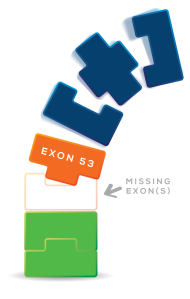
2. DMD Gene Mutation
A mutation or deletion in the DMD gene may impact the way its exons fit together. As you can see above, exon 53 has lost its connecting partner, which prevents the body from making enough usable dystrophin to support skeletal muscles.
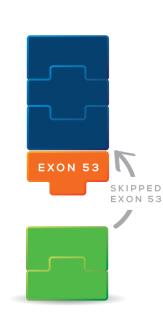
3. EXON 53 Skipping
In DMD patients amenable to exon 53 skipping, VILTEPSO is designed to skip over exon 53. In this case, it skips over the orange block (exon 53) so that the green block can fit next to the blue one.

4. Shortened Dystrophin
By skipping exon 53, VILTEPSO helps the body make a shortened but partially functional form of dystrophin protein.
When is a child’s exon deletion amenable to exon-skipping therapy?
For children diagnosed with DMD, a simple genetic test can identify their specific mutation, which may fall within one of many exon ranges amenable to (eligible for) an exon-skipping therapy such as VILTEPSO.
The Exon Finder Tool demonstrates how this works. Just select an exon range below based on the results of the genetic test, and it can tell you if exon-skipping therapy is an option.
Exon Finder Tool
Select an exon range from the options listed below:3-50
4-50
5-50
6-50
9-50
3-52
4-52
5-52
6-52
9-52
10-50
11-50
13-50
14-50
15-50
16-50
17-50
19-50
10-52
11-52
13-52
14-52
15-52
16-52
17-52
19-52
21-50
23-50
24-50
25-50
26-50
27-50
28-50
29-50
21-52
23-52
24-52
25-52
26-52
27-52
28-52
29-52
30-50
31-50
32-50
33-50
34-50
35-50
36-50
37-50
38-50
39-50
30-52
31-52
32-52
33-52
34-52
35-52
36-52
37-52
38-52
39-52
40-50
41-50
42-50
43-50
45-50
47-50
48-50
49-50
40-52
41-52
42-52
43-52
45-52
47-52
48-52
49-52
50
52
52-58
52-61
52-63
52-64
52-66
52-76
52-77
50-52
54-58
54-61
54-63
54-64
54-66
54-76
54-77
This tool is not intended to deliver a diagnosis or to replace any discussions with your doctor or genetic counselor.
Can’t find your range?
This child may not be eligible for exon-skipping therapy—consult a doctor for more information.
The selected range of exon deletions suggests this child may be eligible for treatment with VILTEPSO!
If your child has been diagnosed with DMD, speak with a doctor about VILTEPSO. Email me this recommendationVILTEPSO: an exon-skipping therapy option
- Designed to bind to and induce skipping of exon 53 of the dystrophin pre-mRNA, resulting in the production of a shortened dystrophin protein that contains essential functional portions
- Patients taking VILTEPSO showed a mean increase in dystrophin levels to 5.9% of normal by week 25 vs 0.6% of normal at baseline
- 100% of patients showed an increase in dystrophin levels
- VILTEPSO can be used to treat patients with DMD with an exon 52 deletion
This selected range of exon deletions suggests this child may be eligible for treatment with an exon-skipping therapy.
If your child has been diagnosed with DMD, speak with a doctor about potential treatment options.What is exon skipping?
- Exon skipping is a genetic technique that assists in “skipping over” an exon
- Exon skipping can be used to treat specific exon deletions
Sign up to receive updates about VILTEPSO
Keep up to date on our latest news and developments.
Stay InformedDiscover NS Support Patient Access Solutions and find links to helpful resources
We’re committed to being a partner to families coping with DMD.
Get SupportInterested in clinical trials for Duchenne muscular dystrophy?
To inquire about ongoing or future VILTEPSO clinical trials, please click the button below to contact us.
Contact Us




Meet the VILTEPSO Ambassadors
Hear and read what real patients and their families have to say about life and treatment with VILTEPSO.
See Patient Stories
Taking VILTEPSO
VILTEPSO is a once-weekly intravenous (IV) infusion that can be given by a healthcare professional at home or at a treatment center.
Here are a few questions you may have about taking VILTEPSO:

Q:
What is an infusion?
An IV infusion goes into the patient’s bloodstream through a small needle and tube. It is a FAST way to get medication directly into the body.

Q:
How much medication is in each VILTEPSO dose?
A healthcare provider will calculate the dose based on the patient’s body weight. 80 MILLIGRAMS of VILTEPSO is given for each kilogram (a kilogram is approximately 2.2 pounds) of weight per week.
Q:
How long is the infusion?
The infusion lasts 60 MINUTES. But plan for some extra time before and after treatment in case there are questions for the nurse, or the patient needs post-treatment observation.

REMEMBER, A DOCTOR IS ALWAYS YOUR BEST RESOURCE FOR information about DMD and determining if VILTEPSO could be the right treatment option for you.
Getting Started & Infusion Overview Guide
Contains essential information about the weekly IV infusion process, and helps answer any questions you may have
Patient Overview Brochure
Explains the features of VILTEPSO in treating Duchenne, including efficacy and safety
Doctor Discussion Guide
Offers helpful questions to ask your doctor when speaking about VILTEPSO
Have questions? Get support today
NS Support Patient Access Solutions is fully committed to providing ongoing support to DMD patients, their caregivers, and healthcare professionals.
Hours
Monday – Friday, 8 AM – 8 PM ET
Phone
1-833-NSSUPRT (1-833-677-8778)

